
Understanding Office Chair Bases and Support Designs
When you sit down at your desk, the entire weight of your upper body rests on a complex system hidden beneath the cushion. Most people look at the upholstery or the armrests first, but the true foundation of any reliable workspace seating lies in its base and support structure. Without a properly engineered foundation, even the most expensive leather executive model will soon begin to wobble, tilt unevenly, or wear out its internal components.
A solid office chair base does much more than simply hold you off the floor. It anchors your posture, absorbs sudden shifts in weight, and determines how smoothly you can glide across the room. Neglecting this part of the chair usually leads to premature wear on the flooring and unnecessary strain on your lower back as you constantly correct for micro-movements and imbalances.
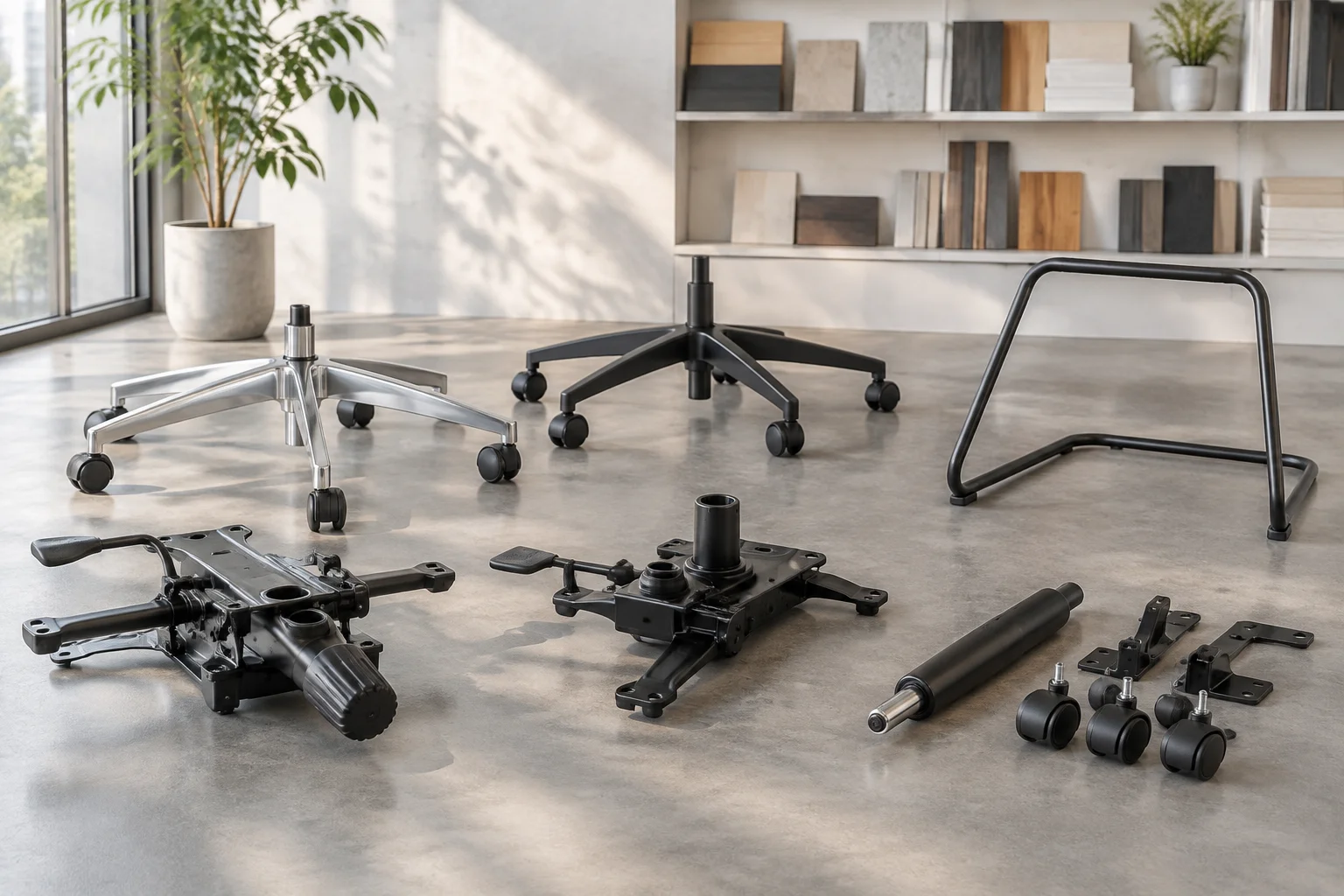
Anatomy of the Five Star Base
The standard design for modern desk seating is the five-star base. This specific geometry is not chosen for aesthetic reasons alone. Four points would tip over too easily when you lean outward, and six points would crowd your feet and add unnecessary weight to the floor assembly.
Spreading the load across five distinct arms ensures that downward pressure radiates outward from the central gas cylinder. When you shift your weight toward the front edge of the seat, at least two arms bear the brunt of the load while the remaining three anchor the opposite side against tipping.
Materials matter immensely here. Plastic bases made from reinforced nylon offer surprising flexibility and absorb minor impacts without cracking. Aluminum and steel variants provide rigid durability and a sleeker industrial appearance, though they tend to transmit more vibration if your floor has uneven tiles or joins.
Swivel Mechanisms and Dynamic Movement
Above the base sits the mechanism box, the mechanical heart of the chair. A good swivel mechanism allows 360-degree rotation while maintaining strict axial alignment. If this joint has too much play, the seat starts to wobble sideways, forcing your core muscles to micro-adjust constantly without your conscious awareness.
Modern support designs incorporate various levels of tilt tension. Some rely on a simple spring coil hidden inside the housing, while others use synchronized pivot points that tilt the backrest and the seat pan at different angles. This coordination keeps your feet flat on the floor even when you lean back to take a phone call.
Key elements that define a reliable swivel mechanism include:
- Thick steel housing plates that resist bending under eccentric loads
- Sealed ball bearings that prevent dust accumulation inside the rotation axis
- Adjustable tension knobs for dialing in the exact resistance you prefer
- Heavy-duty retaining clips that secure the central piston firmly
- Integrated tilt-lock levers that immobilize the rocking motion instantly
- Precision-molded washers that eliminate metallic scraping sounds
Fixed Leg Structures for Specialized Work
Not every chair needs to roll across the room. For drafting tables, recording studios, and reception areas, fixed-leg structures offer a completely different set of mechanical advantages. Removing the casters and the spinning axis eliminates any possibility of drifting away from your work surface while applying pressure.
These stationary bases usually feature four legs or a looped sled base. Sled bases distribute downward force across two continuous metal runners, which works exceptionally well on carpeted floors where standard wheels tend to sink and drag. The absence of moving parts also means there are virtually no components to loosen or squeak over years of daily service.
Choosing between a rolling base and fixed legs depends entirely on your daily routine. If your tasks require you to pivot between multiple monitors and reference shelves on opposite sides of the room, a wide five-star rolling base is indispensable. If you spend hours soldering small circuits or drawing fine lines on paper, a stable fixed frame keeps your body centered and eliminates distracting movements.
Evaluating Overall Stability and Daily Wear
Examining the connection points where the base meets the gas cylinder reveals a lot about the manufacturing quality of a chair. Tapered friction fits hold these parts together under thousands of Newtons of force, meaning that a poorly machined socket will inevitably loosen over time and start to drop or tilt.
Regular maintenance can extend the lifespan of any support system significantly. Dust and carpet fibers tend to wrap around the caster axles, binding the wheels and forcing the base to drag across the floor rather than roll. Cleaning out these debris accumulation points every few months restores smooth movement and protects your flooring from scuff marks.
Inspecting your chair from the ground up gives you a clear picture of how well it handles the physical demands of a full workday. Pay attention to how the base reacts when you shift your weight, listen for unusual metal creaks inside the housing, and make sure every bolt remains tightly seated within its threading.
Comments
"I never realized how much difference a proper five-star base makes until I swapped out my old wobbly chair. The weight distribution feels completely different now, and my desk setup finally stays rock solid all day."
Arman Petrosyan
"Reading about caster resistance and base span really changed my perspective on office furniture. Viewxenro gave me the exact technical details I needed to choose a sturdy base that fits my narrow workspace perfectly."
Anush Harutyunyan
"The breakdown of swivel mechanisms helped me figure out why my previous seat kept tilting to one side. Switched to a fixed-leg structure for my drafting desk, and the stability improvement is night and day."
Gor Sargsyan